Summary
This is a review of what the evidence actually says about spacing children’s practice out over time, written for Australian parents rather than for teachers.
Four findings carry most of the weight:
-
Australia has a measured problem. Roughly one in three Australian children do not reach proficiency in reading, and roughly one in three do not reach it in maths. This is not a matter of opinion. It is the finding of two Grattan Institute reports and it is broadly consistent with national NAPLAN data.
-
The Australian Government’s own research body already recommends the fix. The Australian Education Research Organisation (AERO) publishes a practice guide on spacing and retrieval practice, and NSW’s What Works Best 2025 evidence guide places the same principle at the centre of explicit teaching.
-
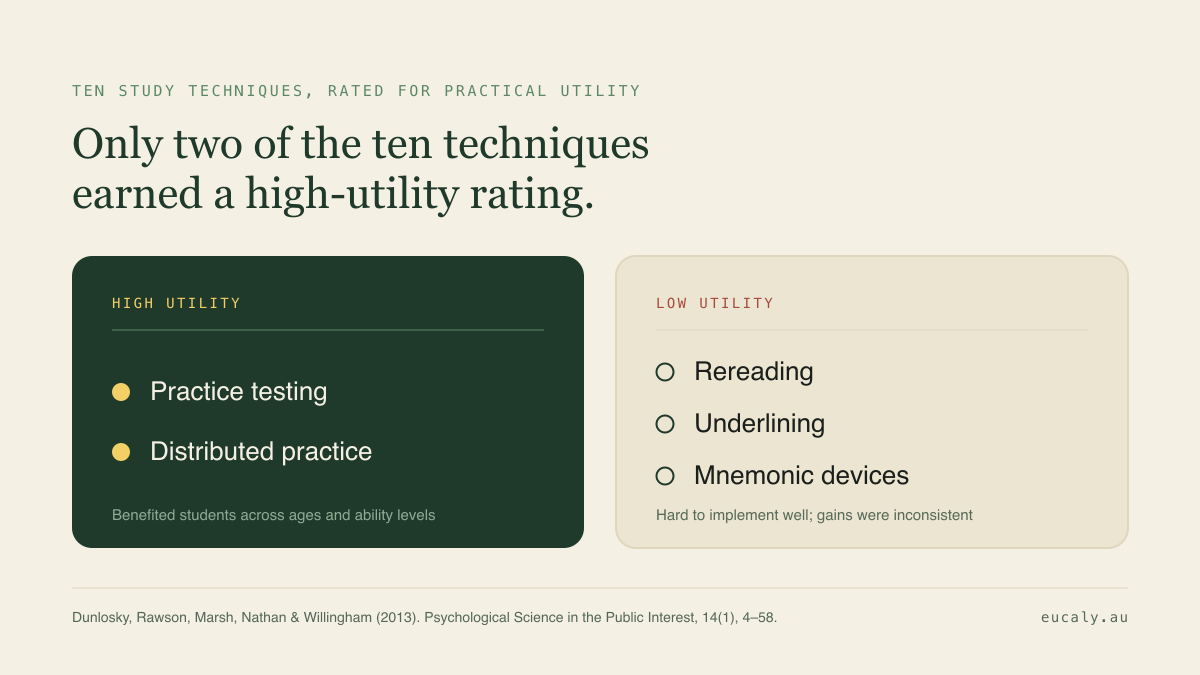
The underlying science is unusually settled, and still being confirmed. A 2006 meta-analysis drew on 839 separate assessments of distributed practice. A 2013 review in Psychological Science in the Public Interest rated ten popular study techniques and found only two to be of high utility across ages and ability levels. Distributed practice was one of them; rereading and underlining, which are what most students actually do, were rated low. A meta-analysis published in July 2025 found the spacing advantage holding up in mathematics specifically, while also finding the retrieval-practice case in maths less settled than is often claimed.
-
Almost none of it has been translated for families. The Australian guidance is written for classrooms, for teachers, with lesson sequences and review schedules. Very little of it has been rewritten for the place where most of a child’s independent practice actually happens, which is a kitchen table on a weeknight.
That fourth point is the reason this review exists.
1. The problem, as measured
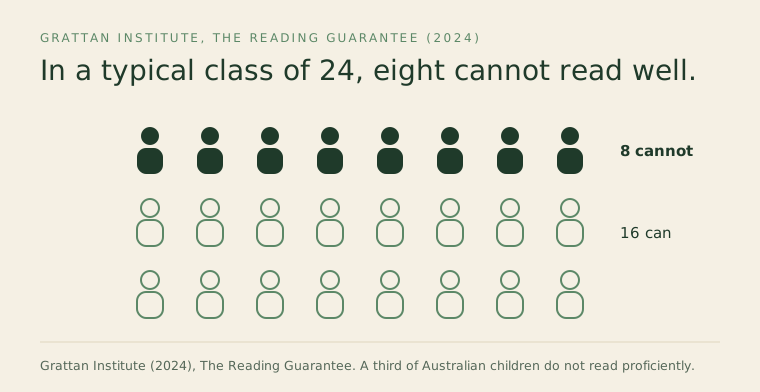
In February 2024 the Grattan Institute published The Reading Guarantee: How to give every child the best chance of success. Its central finding was that a third of Australian children cannot read proficiently. The report put it in a form that is harder to look away from: in a typical Australian classroom of 24 students, eight cannot read well. Grattan proposed a national target of 90 per cent of children reading proficiently, requiring an increase of at least 15 percentage points over ten years.
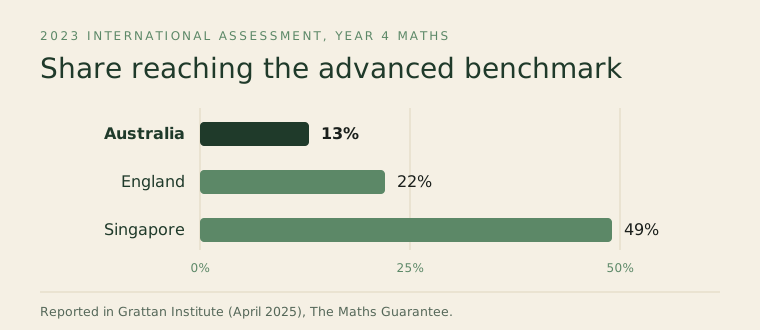
In April 2025 the same institute published The Maths Guarantee: How to boost students’ learning in primary schools, and found a comparable picture in numeracy. One in three Australian students fail to achieve proficiency in maths. The figure is worst among disadvantaged students, but it is not confined to them: one in five students from well-off families struggle too. In a 2023 international maths assessment, only 13 per cent of Australian Year 4 students reached the advanced benchmark, against 22 per cent in England and 49 per cent in Singapore.
The national assessment data tells a compatible story. ACARA released the NAPLAN National Results for 2025 on 30 July 2025. Two in three students sat at the Strong or Exceeding proficiency levels in reading, numeracy and writing, and about one in ten sat at Needs additional support. Participation rebounded to 93.8 per cent, the highest since 2017. Results were broadly stable between 2023 and 2025.
Stable is the word worth pausing on. The gap is not widening dramatically, but it is not closing either. Whatever is currently being done is holding the line rather than moving it.
2. What Australian evidence bodies recommend
The interesting thing about the Australian evidence landscape is that the recommendation is already clear and already public. It simply has not reached most parents.
AERO, the Australian Education Research Organisation, publishes a practice guide on spacing and retrieval practice. It defines the two terms precisely:
Spacing is “the practice of sequencing learning so that information is delivered across two or more lessons rather than just one.”
Retrieval practice is “the strategy of getting students to actively recall their learning.”
Spaced retrieval is “the active practice of recalling previous learning at a point in time after the initial lesson.”
AERO’s guidance on timing is refreshingly undogmatic. It notes that “the specific length of the time between the initial lesson and asking your students to retrieve information (for instance, one day or one week) is not as important as ensuring that you use spacing in the first place.” The evidence it cites indicates that separating learning by at least one day, rather than concentrating it into a single session, is useful for maximising long-term retention.
The NSW Department of Education reaches the same place through its What Works Best 2025 evidence guide, which describes explicit teaching as an approach grounded in cognitive science and demonstrated through applied classroom research. Its review-of-learning materials are strikingly concrete: content taught for the first time is scheduled for its first review roughly two days later, then again at widening intervals. Some NSW schools have adopted a whole-school review routine, partly because a predictable routine reduces the cognitive load of the review itself.
Cognitive Load Theory, which underpins much of that guidance, is itself an Australian export. It was developed by John Sweller at UNSW and has since been supported by hundreds of randomised controlled studies internationally. Sweller has continued to publish on it recently, including a 2023 paper in Educational Psychology Review on the theory’s development, a 2023 special issue of the British Journal of Educational Psychology containing nine papers on novel cognitive load research questions, and a 2024 paper on cognitive load theory and individual differences.
The practical consequence of cognitive load theory for a parent is simple and slightly counterintuitive: a long session is not merely inefficient, it can be actively worse, because working memory saturates. A child who is 90 minutes into a maths session is not learning at the rate they were at minute ten.
3. The international foundation
Australian guidance rests on an international evidence base that is among the more settled in educational psychology.
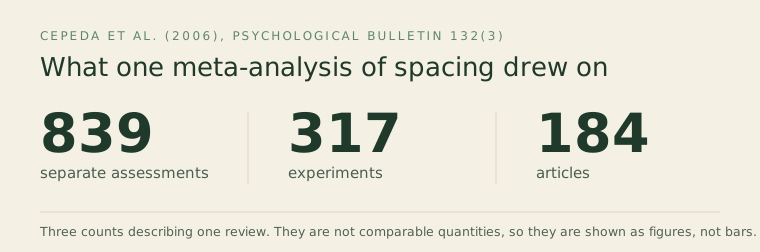
Cepeda, Pashler, Vul, Wixted and Rohrer (2006) published a meta-analysis in Psychological Bulletin covering 839 assessments of distributed practice drawn from 317 experiments across 184 articles. Spacing learning episodes out, rather than massing them together, produced better retention. The size of the advantage depended on how the intervals were arranged, which set up the more precise question the same group tackled next.
Cepeda, Vul, Rohrer, Wixted and Pashler (2008), in Psychological Science, taught more than 1,350 people a set of facts, gave them a review after a gap of up to 3.5 months, and then tested them after a further delay of up to a year. They found an optimal gap, one that first rises and then falls as spacing increases. Expressed as a proportion of how long you need to remember something, the optimal gap declined from roughly 20 to 40 per cent of a one-week retention interval down to roughly 5 to 10 per cent of a one-year interval.
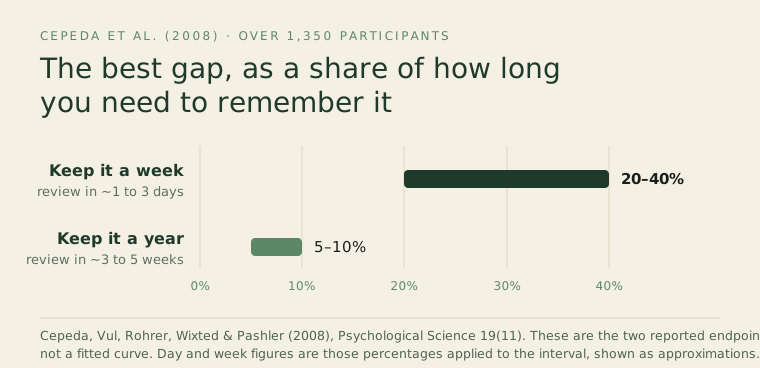
Translated crudely: if your child needs to hold onto something for a school term, the useful review gap is measured in days, not months. If they need it for years, spacing of weeks is appropriate. Either way, the answer is never “once, intensively, and then never again.”
Dunlosky, Rawson, Marsh, Nathan and Willingham (2013) published a review in Psychological Science in the Public Interest assessing ten common study techniques for their practical utility. Two were rated high utility, on the grounds that they benefited students across many different ages and ability levels: practice testing and distributed practice. Three of the most popular techniques among students, rereading, underlining and mnemonic devices, were rated low utility, described as difficult to implement properly and often producing inconsistent gains.
This is worth restating plainly, because it is the single most useful thing in this review. The two things that reliably work are spacing practice out and testing yourself. The thing most children actually do, which is reading over their notes again, is among the things that do not.
Has any of this held up?
A fair question to ask of findings first synthesised two decades ago, and one worth answering directly rather than assuming.
It has, and the checking is ongoing. Murray, Horner and Göbel published a meta-analysis in Educational Psychology Review on 29 July 2025, looking specifically at spacing and retrieval practice in mathematics. Across 27 studies and 53 effect sizes, spaced practice beat massed practice with a small-to-medium effect (g = 0.28). The effect was larger when the practice was isolated from regular coursework (g = 0.43, 10 studies) than when it was embedded inside a course (g = 0.24, 17 studies).
So the direction of the 2006 and 2008 findings survives into 2025 in a subject Australian parents care about a great deal. It is worth being precise about the size, though: this is a modest effect, not a transformation, and the same paper found something more awkward that section 6 deals with honestly.
The reason the older work still anchors this review rather than being replaced by the newer is that meta-analyses aggregate rather than expire, and the spacing effect is one of the most replicated results in psychology, tested since the 1880s. Age is evidence of durability here, not staleness. AERO’s current guidance rests on precisely this literature.
4. The gap this review is trying to close
Everything above is written for schools. AERO’s guide addresses teachers planning lesson sequences. NSW’s materials assume a Stage 4 science teacher with a spreadsheet and a timetable. Grattan’s recommendations are addressed to principals and to governments, and are costed per student per year.
None of that is a criticism. It is appropriate that education research speaks to educators.
But it leaves a gap. A child in an Australian school spends a few hours a week on any given strand of literacy or numeracy, and their teacher is running a spaced review schedule across 24 or more children with different gaps. The practice a child does outside school hours is, for most families, unstructured. It is a worksheet from a tutoring centre on a Saturday, or a burst of activity in the fortnight before an assessment, or nothing at all.
The evidence says fairly clearly that this is the wrong shape. One long weekly session is the massed-practice condition in almost every study cited above. It is the condition that loses.
5. What this means at a kitchen table
Translating the research into household terms, without overclaiming:
Short and frequent beats long and occasional. This follows directly from the distributed practice literature and from AERO’s guidance that separating learning by at least a day supports long-term retention. Fifteen or twenty minutes on four or five days will generally do more than ninety minutes once.
Practice should involve recall, not review. Reading over a page is not retrieval. Answering a question without looking at the answer is. This is the difference between the low-utility and high-utility techniques in Dunlosky et al., and it is the single easiest thing for a family to change.
Difficulty should be near the edge of what the child can do. This is the cognitive load implication. Work that is far too easy produces little learning; work that is far too hard saturates working memory and produces frustration rather than retention.
Returning to old material is not wasted time. It feels like going backwards. The spacing literature says it is the opposite: the return visit is where retention is actually built.
Consistency matters more than optimisation. AERO’s own position is that the precise interval matters less than the fact of spacing at all. Parents should take the pressure off themselves accordingly. A rough daily habit beats a perfect schedule that nobody sustains.
6. What the evidence does not say
A review that only reports supporting findings is advocacy, not evidence. Several limits are worth stating.
Most of the core spacing studies are laboratory studies of verbal recall. Cepeda et al. (2006) is explicitly a synthesis of verbal recall tasks. Retaining vocabulary or facts is not the same cognitive task as constructing an argument in a piece of persuasive writing, and the evidence transfers less cleanly to open-ended work than to knowledge and procedural fluency.
In mathematics specifically, the retrieval-practice half of the story is not settled. This is the most important qualification in this review, and it comes from its most recent source. Murray et al. (2025) found that while spacing clearly helped maths learning, testing yourself versus simply restudying produced an effect of g = 0.18 across 7 studies, with a 95 per cent confidence interval crossing zero.
In plain terms: when those studies were pooled, the range of plausible results included “no difference at all”. The researchers cannot rule out that, in maths, a child who tests themselves ends up no better off than a child who simply goes over the material again. It might help. It might not. Seven studies is not enough to tell.
Two things that finding is not. It is not evidence that retrieval practice fails, and it is confined to mathematics. Dunlosky et al. rated practice testing high-utility across domains generally, and that still stands. But anyone telling you the maths case is closed is going beyond what the evidence currently supports, and we are not going to tell you that.
The optimal-gap figures are population averages. They describe the shape of a curve across more than a thousand people. They are not a prescription for an individual child, and no parent should be running the numbers.
None of this evidence addresses motivation. The research answers the question “given that a child practises, how should that practice be arranged?” It does not answer “how do I get my child to practise at all?” That is often the harder problem, and it is substantially outside what this literature can tell you.
Practice is not a substitute for teaching. Both Grattan reports are, at their heart, about the quality of classroom instruction. Practice consolidates what has been taught. It does not replace it, and a child who has not been taught something well will not learn it through repetition alone.
Australian implementation evidence is still thin. AERO and NSW are recommending these practices, and the international evidence behind them is strong, but large-scale Australian outcome data on home-based spaced practice specifically is not something this review can point to, because it does not really exist yet.
7. Where we sit
We build Eucaly, a daily practice app for Australian children in Years 3 to 9, aligned to the Australian Curriculum. The design follows from the evidence above: short sessions, spaced across the week, built on recall rather than review, with difficulty that adapts to the child.
We have a commercial interest in this conclusion, which is exactly why every claim in this review is sourced to somebody other than us, and why section 6 is in it. If the evidence had said that one long weekly session works best, that would have been a serious problem for our product, and it would still have been the finding.
Readers who want to go to the primary material should start with the AERO practice guide, which is free, short, and written more clearly than most things in this field.
References
Australian sources
- Australian Education Research Organisation (AERO). Spacing and retrieval practice practice guide. edresearch.edu.au
- Australian Education Research Organisation (AERO). Tried and Tested: Spacing and retrieval practice. edresearch.edu.au
- Grattan Institute (February 2024). The Reading Guarantee: How to give every child the best chance of success. grattan.edu.au
- Grattan Institute (April 2025). The Maths Guarantee: How to boost students’ learning in primary schools. grattan.edu.au
- NSW Department of Education (2025). What Works Best 2025: Evidence guide for excellent schools, and the accompanying explicit teaching practical guide and review-of-learning materials. education.nsw.gov.au
- Australian Curriculum, Assessment and Reporting Authority (ACARA), 30 July 2025. NAPLAN National Results 2025. acara.edu.au
- Sweller, J. (2023). The development of cognitive load theory: Replication crises and incorporation of other theories can lead to theory expansion. Educational Psychology Review.
- Sweller, J. (2024). Cognitive load theory and individual differences. Learning and Individual Differences.
- British Journal of Educational Psychology (2023). Special issue on cognitive load theory, nine papers.
International foundation
- Murray, E., Horner, A. J., & Göbel, S. M. (2025). A meta-analytic review of the effectiveness of spacing and retrieval practice for mathematics learning. Educational Psychology Review, published 29 July 2025.
- Cepeda, N. J., Pashler, H., Vul, E., Wixted, J. T., & Rohrer, D. (2006). Distributed practice in verbal recall tasks: A review and quantitative synthesis. Psychological Bulletin, 132(3), 354 to 380.
- Cepeda, N. J., Vul, E., Rohrer, D., Wixted, J. T., & Pashler, H. (2008). Spacing effects in learning: A temporal ridgeline of optimal retention. Psychological Science, 19(11), 1095 to 1102.
- Dunlosky, J., Rawson, K. A., Marsh, E. J., Nathan, M. J., & Willingham, D. T. (2013). Improving students’ learning with effective learning techniques: Promising directions from cognitive and educational psychology. Psychological Science in the Public Interest, 14(1), 4 to 58.
Last reviewed 14 August 2026. If you spot an error in how we have represented any of this research, we would genuinely like to know: help@eucaly.au