
The report arrives and the first thing most parents do is scan for letters. An A feels like relief. A C feels like concern. That instinct is understandable, but it is reading the wrong thing into the scale.
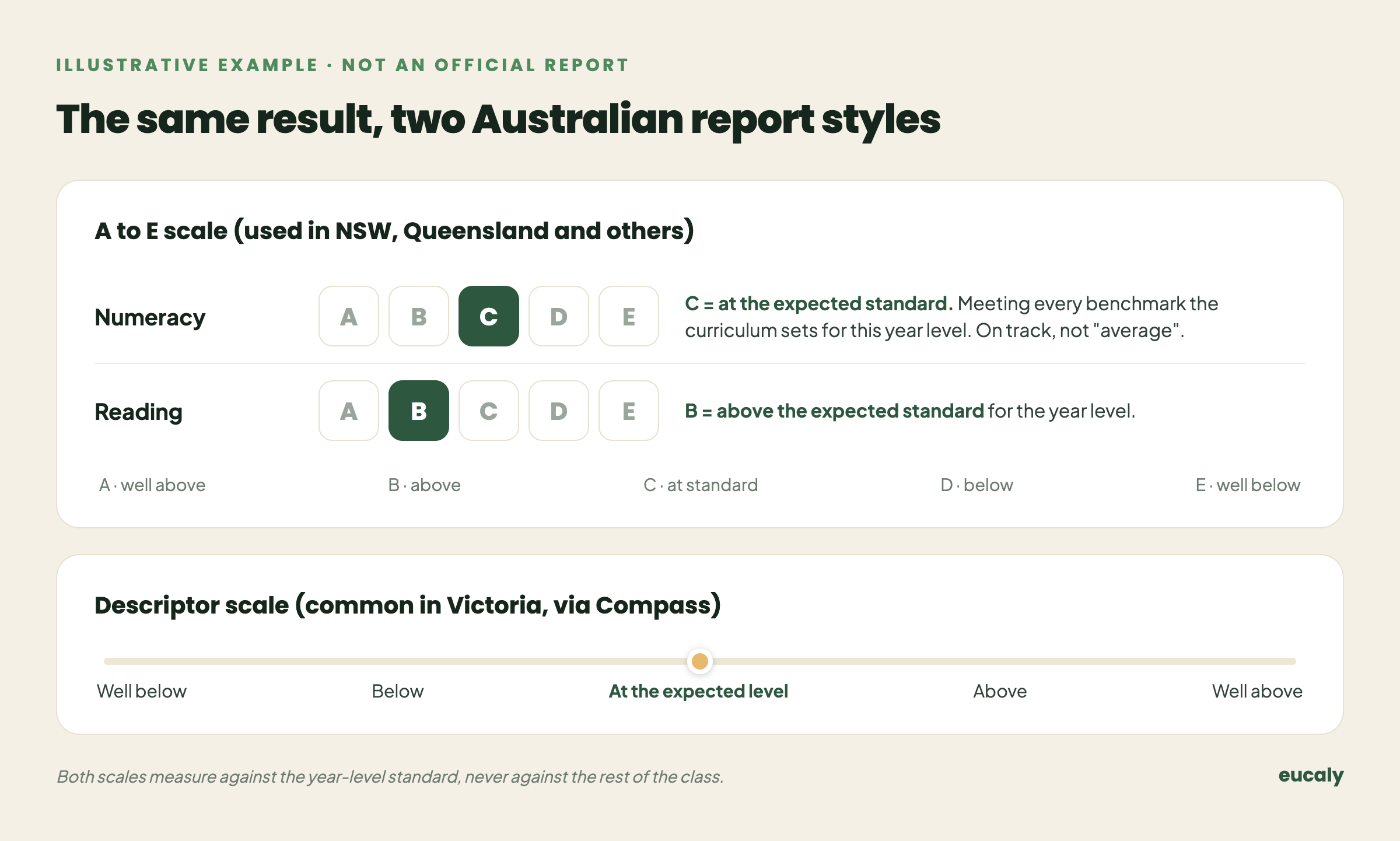
Australian school reports do not rank children against each other. They measure a child against the expected standard for their year level. That is a meaningful distinction. A C does not mean your child is average relative to the class. It means your child is working at exactly the level the curriculum expects for a child in that year. On track. Meeting the standard. Where they should be.
A B means above the expected level. An A means well above it. A D means the child is working below what is expected, and an E means well below. The scale is anchored to curriculum, not to a classroom of thirty kids where someone has to come last.
This matters more than it sounds. A child who receives a C in every subject at Year 6 has demonstrated that they are meeting every standard the Australian Curriculum sets for an eleven or twelve year old. That is not a middling result. That is the intended outcome for most children at that age.
Some schools, particularly in Victoria, do not use letters at all. They use descriptors on a curriculum level line, often reported through platforms like Compass: well above, above, at, below, or well below the expected level. The meaning is identical to the A to E scale. The framing is just more explicit about what is actually being measured.
Here is the part that most parents move past too quickly. The letter or descriptor tells you where a child landed at the point of assessment. The teacher comment tells you why, and what comes next. A report that says a child is at the expected level and adds that they are working more carefully through multi-step problems is telling you something specific. The skill is emerging. The habit is forming. There is direction in that sentence if you read it slowly.
Conversely, a report that says a child is above the expected level but notes that they sometimes rush and make careless errors is also telling you something. The grade reflects their ceiling. The comment reflects their floor. Both are useful.
One thing worth knowing: a child can understand a concept during a lesson and still score below expectations on a report. That is not a contradiction. It usually means the understanding was not yet stable enough to survive three weeks without practice. New learning fades quickly when it is not revisited. The report is often measuring what consolidated, not what was briefly grasped.
That gap between grasping and retaining is where most of the work actually lives. It is also where a lot of parental confusion comes from. A child who seemed to understand fractions in Term 2 and then struggles with them on the Term 3 report has not gone backwards. The knowledge was never fully set.
One more distinction worth keeping clear. This report comes from your school twice a year and reflects your child’s teacher’s judgement against the curriculum standard. The NAPLAN report that arrives after the March tests is a different document entirely: a national scale with four proficiency levels, and no letter grades anywhere on it. We have a separate guide to reading your child’s NAPLAN results.
Eucaly is built around this problem specifically, offering daily ten-minute practice across Reading, Writing, Numeracy and Language Conventions, aligned to the Australian Curriculum for Years 3 to 9, with a parent portal that maps results against NAPLAN proficiency standards so you can see where things are holding and where they are slipping.
Reading a school report well means holding the grade and the comment together. The grade tells you the standard reached. The comment tells you the shape of how the child is working. Neither one is the whole picture on its own.